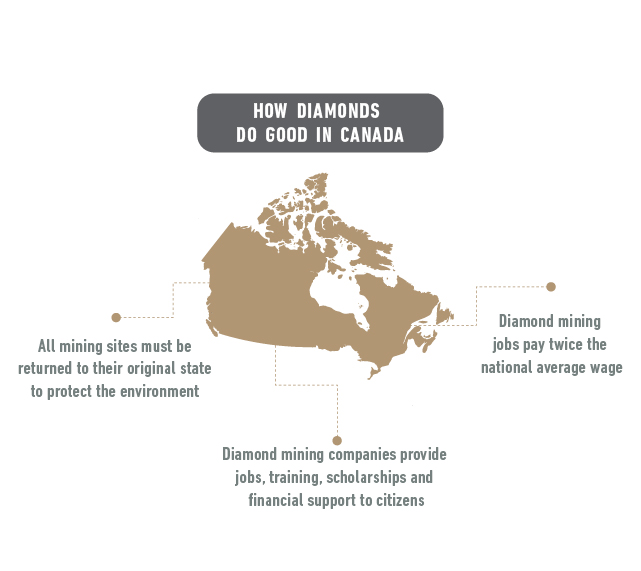
All mining sites must be returned to their original state to protect the environment
Diamond mining jobs pay twice the national average wage
Diamond mining companies provide jobs, training, scholarships and financial support to citizens

Map Legend
Diamond Mines in Canada
- LOCATION : Russia
- CAPITAL : Moscow
- COORDINATES : 61.5240° N, 105.3188° E
- FLAG :

- Fun Fact:In 2019, Alrosa discovered what people quickly dubbed the “matryoshka” diamond. Named after the iconic Russian nesting dolls, this naturally green diamond contained a smaller diamond inside of it that could rattle around freely! This one-of-a-kind diamond was sent to GIA for examination.
- Title 2 :Lorem ipsum dolor
- Title 3 :Lorem ipsum dolor
We live in an interconnected world where the actions of one community necessarily impact the welfare of another. In creating the Diamond Origin Report, our goal is to make diamonds a force for positive social change, because greater transparency leads to greater corporate accountability. Transparency through Diamond Origin Reports encourages businesses to compensate employees fairly, maintain safe working conditions, operate mines sustainability and restore habitats to their original states after mines expire. In purchasing a diamond with a GIA Diamond Origin Report, you help the world and the industry shine brighter.
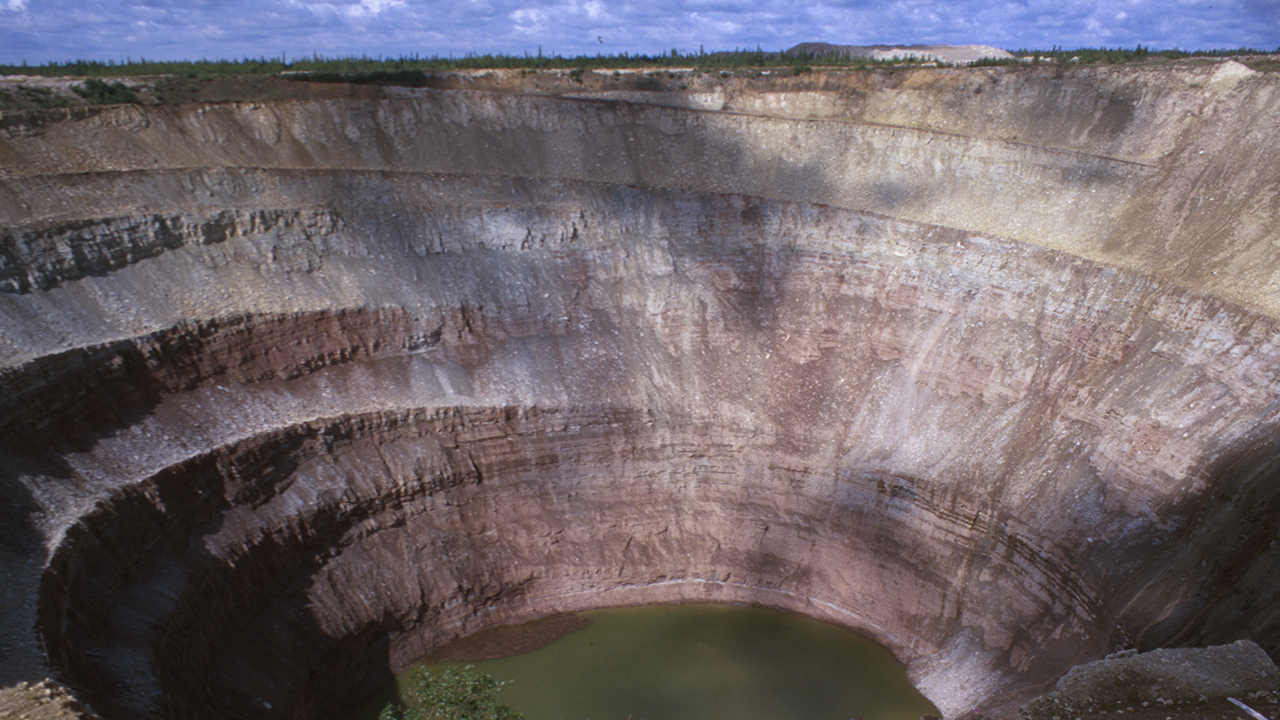
Mirny is a remote Siberian town located well above the tundra line in the sub-arctic. The area’s largest employer, the diamond producer Alrosa, donates the equivalent of US$4 million each year to make sure children in the area receive a quality education and is the single largest source of revenue for the schools in that difficult-to-access area. The company contributes about 3% of its annual revenue to social projects, as a long supporter of local communities, generously contributing to the development of not only education, but healthcare, culture and sports. They help organize and sponsor charity events for students of local districts making community responsibility one of their company pillars.
Russia and Alrosa were charter adopters of the Kimberley Process. Since its 2013 reorganization into a public company, it has developed its own set of best business practices. It pays wages and benefits well above average and has enacted state-of-the-art safety policies at its mines. Alrosa also has taken measures to increase the transparency of its operations by publishing detailed annual reports and working with the diamond industry worldwide to promote sales of diamonds mined by ethical producers.
Russia also has an emerging diamond cutting industry, accounting for thousands of additional jobs in cities like Smolensk and Vladivostok, further contributing to the economy and well-being of the people of Russia. Diamond industries in both the rough and polished sectors contribute greatly to Russia’s economy, supporting education and healthcare throughout the country and helping to protect and preserve the environment in mining communities.

Russia is the world’s largest diamond-producing nation by volume, with 42 deposits in operation – 16 primary sources and 26 alluvial sites – yielding over 40 million carats of rough diamonds each year. Approximately 90% of Russia’s diamonds are mined in the province of Sakha near the Arctic Circle. A newly discovered site near the port of Arkhangelsk in the far northwestern portion of the country has also been developed.
Although geologists long-suspected the existence of diamond deposits in Russia, their suspicions were not confirmed until the mid-1950s when a small team of geologists, headed by Larisa Popugaeva, found kimberlite in a remote and forbidding region of Siberia. In this once barren region, a community grew, and today the mining town of Mirny boasts a population of around 40,000, with an entire infrastructure supported by the diamond industry. Though Mirny had emerged as a mining town, it has evolved into a modern center of economic and cultural activity in Western Yakutia.
The country’s diamond industry was reorganized in 1991 when the diamond-producing province of Sakha (formerly Yakutia) became a semi-independent state. In 1992, the government created a new diamond administration agency. This organization, with the majority of shares held between the government in Moscow and the provincial government in Yakutsk, was named Alrosa.